

Facsimile · read in full
A health-management report
- Reference
- BH-2026-0421 · sample
- Prepared for
- M., 34 — an invented reader, for this sample
- Written by
- Name and licence number removed for this sample
- Read again by
- A second physician of the house
- Written
- 12 August 2026
- Length
- Six pages, seven parts
Page one · never folded away
Before you read the rest
Some things do not belong in a report like this one. If any of the following is true for you, stop here and see someone in person. This is not for us to look at from a distance.
- Blood in your urine or stool, or vomiting blood.
- Chest pain, pressure, or breathlessness that comes on with effort.
- A headache that arrived suddenly and was the worst you have had.
- Weight loss you did not intend, more than a few kilograms over a few months.
- A lump that is new, hard, or growing.
- Fever that has lasted more than a week.
- New weakness, numbness, or trouble speaking.
- You are pregnant, or think you might be.
- You are on prescription medication and are thinking of changing it.
Nothing in your report is a reason to delay care, and nothing in it should replace a doctor who can put hands on you.
01
What you told us
You are thirty-four. You work from home four days in five, at a desk, and you filled in this form because two rounds of blood work in eighteen months came back unremarkable and you still feel — your words — like a battery that no longer holds its charge.
What you described: waking between three and four in the morning on about four nights a week, and lying there for an hour with a warm head and cold feet. A flat stretch every afternoon from roughly two until four, worse after lunch than before it. Hands and feet that stay cold indoors even in August. A first visit to the bathroom in the morning that is loose and never quite finished. Bloating after lunch that eases by evening. Appetite normal, or normal until recently. A preference for hot drinks that you have never thought about. And a salad eaten at the keyboard most working days, because it is quick.
You take no regular medication. At the bottom of the form you wrote: I am not ill. I am running at about seventy per cent and I would like to know why. That sentence did more work in this reading than most of the thirty answers above it.
02
What the tongue showed
Photograph taken at 07:41, at a north-facing window, before brushing. It is a good photograph; nothing had to be sent back.
The body of the tongue is pale — lighter than the pink of your inner lip, which is the comparison we make — and slightly swollen, so that the lower teeth have pressed a scalloped edge along both sides. We count about ten shallow indentations, more on the left than the right. The coating is thin, white and wet; light comes back off it in the photograph, and that reflection tells us about fluid as reliably as the colour does. There is no crack down the centre. The tip is not red.
This is not a dramatic tongue. It is a quiet one — and quiet ones belong to the people who are most often told that there is nothing to find.
03
The pattern
脾气虚兼湿 — pí qì xū jiān shī. In English: the spleen system running below its usual output, with fluid that is not being moved on.
Two things have to be said before anything else. The spleen of Chinese medicine is not the organ a surgeon would point at; it is the name this tradition gives to the whole business of taking food apart and distributing what comes out of it, closer to what you might call the digestive and metabolic side of things than to any single piece of anatomy. And a pattern is not a disease. Nothing here has a name in your own doctor’s vocabulary, nothing here rules anything in, and nothing here rules anything out.
What the pattern says is this. The part of you that turns lunch into the afternoon is working at a discount. When that happens, three things tend to follow in a predictable order, and you have all three. Energy drops in the middle of the day rather than in the morning, because the middle of the day is when the work is being asked for. Fluid that ought to be moved along sits where it is instead — which is the swollen tongue, the scalloped edge, the wet coating and the bloating, all of them one observation seen from four sides. And warmth stops reaching the ends of you, because there is not much spare to send out that far.
Where we are less certain. The three-in-the-morning waking is the part that fits least neatly, and it is exactly where feeling your pulse would have been worth having. Waking at that hour with a warm head can belong to a different pattern altogether, one with more heat in it than anything we can see here. Your tongue does not support that reading and the rest of your answers do not either, so we have set it aside rather than built on it. If six weeks from now the afternoons have changed and the nights have not moved at all, that is the reading to go back to — and it is worth saying so to whoever you see next.
04
The shape of a day
None of this costs money or needs an appointment. It is set out in the order of how much difference it usually makes, and if you only manage the first two you will have done most of it.
- Eat breakfast warm and cooked, within an hour of waking. Not fruit, not yoghurt, not a cold smoothie. Congee, oats made with boiling water, eggs, soup — anything that arrives hot. This single change alters the afternoon more than the other five together.
- Make lunch the largest meal, and sit down to it. Twenty minutes at a table rather than eight at a keyboard. The bloating you described is partly a question of what you eat and substantially a question of how fast.
- Walk for twenty minutes afterwards. Chinese has a phrase for it — 饭后百步走, a hundred steps after eating. It is not exercise. It is the difference between bloating at three o’clock and not.
- Keep your feet warm indoors. Socks in August is not a joke in this office. The ends of you are where this pattern shows first and where it eases first.
- Lights low by half past ten, in bed before eleven. The old organ clock gives the hours from eleven at night to three in the morning to the gallbladder and the liver, and calls that the window in which the day is settled. Whatever you make of the model, the sleep you are currently missing is the sleep before midnight.
- Nothing to eat after nine. The system you are trying to give a rest to is the one that stays up to do it.
05
What to eat, what to ease off
Everything below is food, sold as food, and eaten as food. It comes from the shared-origin tradition — 药食同源, yào shí tóng yuán, the old observation that what is in the kitchen and what is in the pharmacy grew on the same hillside. We are not sending you anything and we are not asking you to buy anything you would not find in an ordinary shop.
Three to add
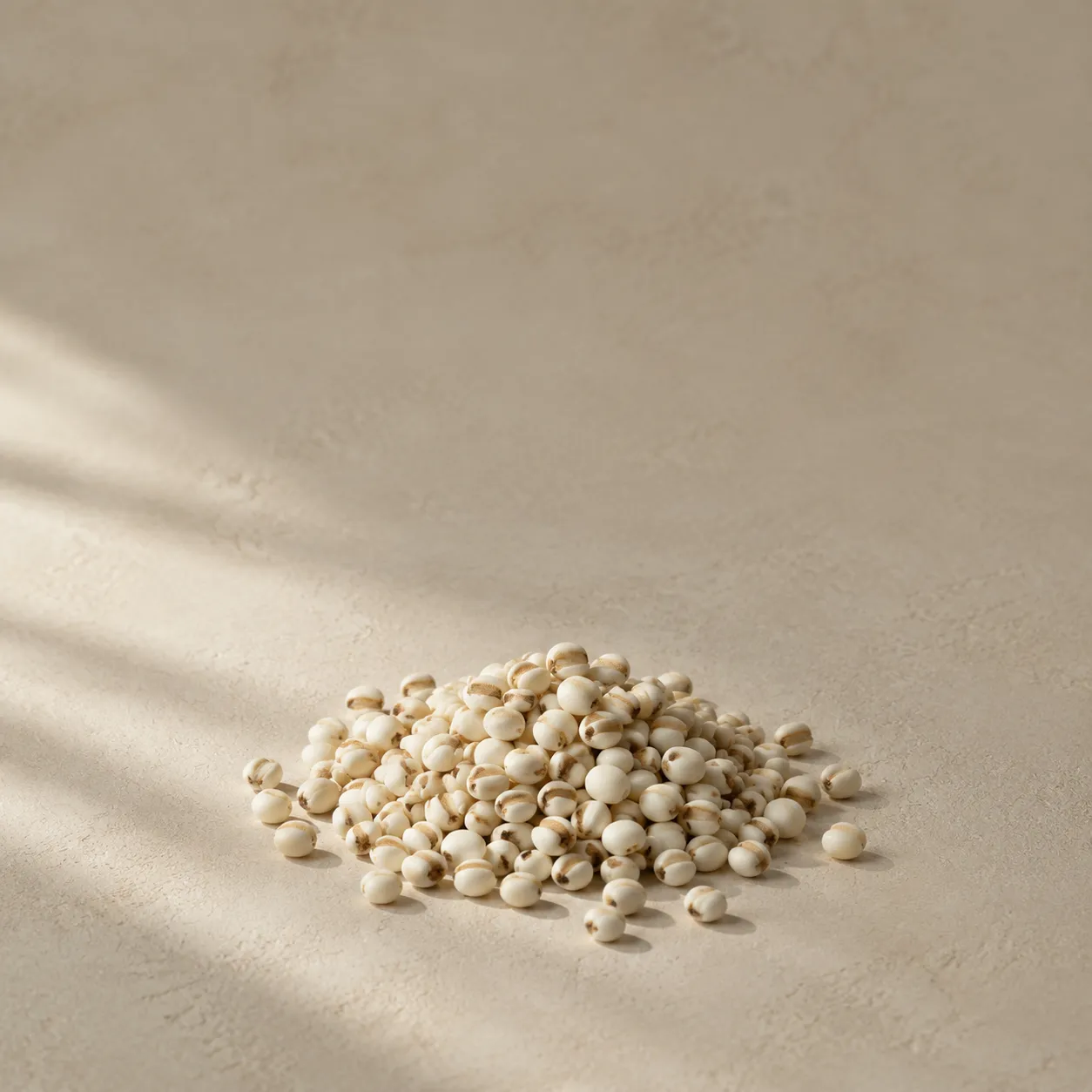
薏苡仁Job's tears
HowSimmered into a soft congee with rice, roughly one part to four, for about forty minutes. A bowl on three or four mornings a week, warm, with a little salt rather than sugar.
Why hereOf everything on the shared-origin list, this is the grain most associated with moving standing fluid. It sits in the Bencao Gangmu of 1596 and in every Chinese supermarket, and in the kitchen it is simply a grain that needs a long cook.
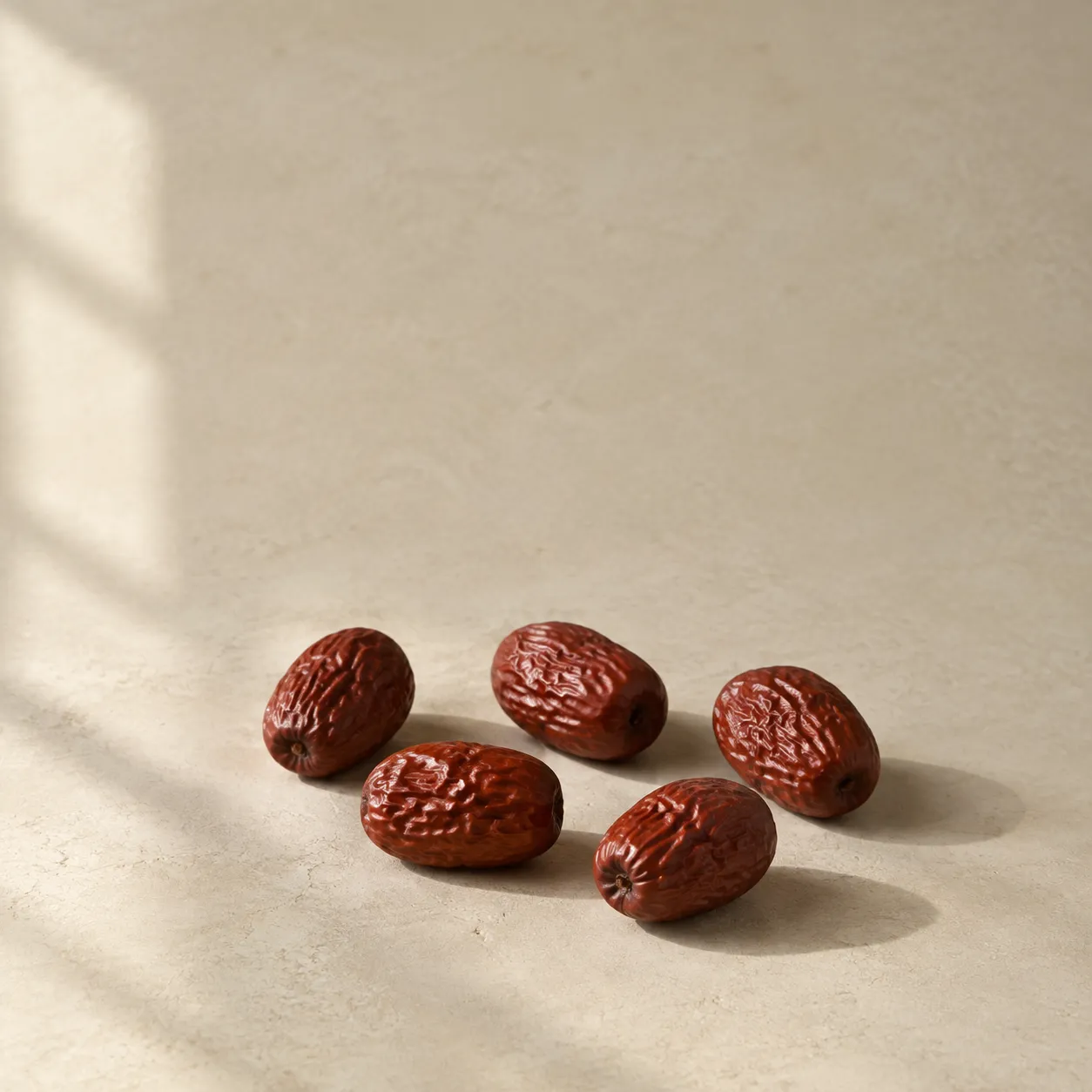
大枣Red jujube
HowTwo or three, split open with a thumbnail so the inside opens to the water, dropped into whatever is already simmering. Cooked, never eaten raw and dry.
Why hereSweet and warming, and the oldest way in Chinese cooking of supporting the middle without weighing it down. It appears beside ginger in more than fifty of the formulas recorded in the Shanghan Lun.
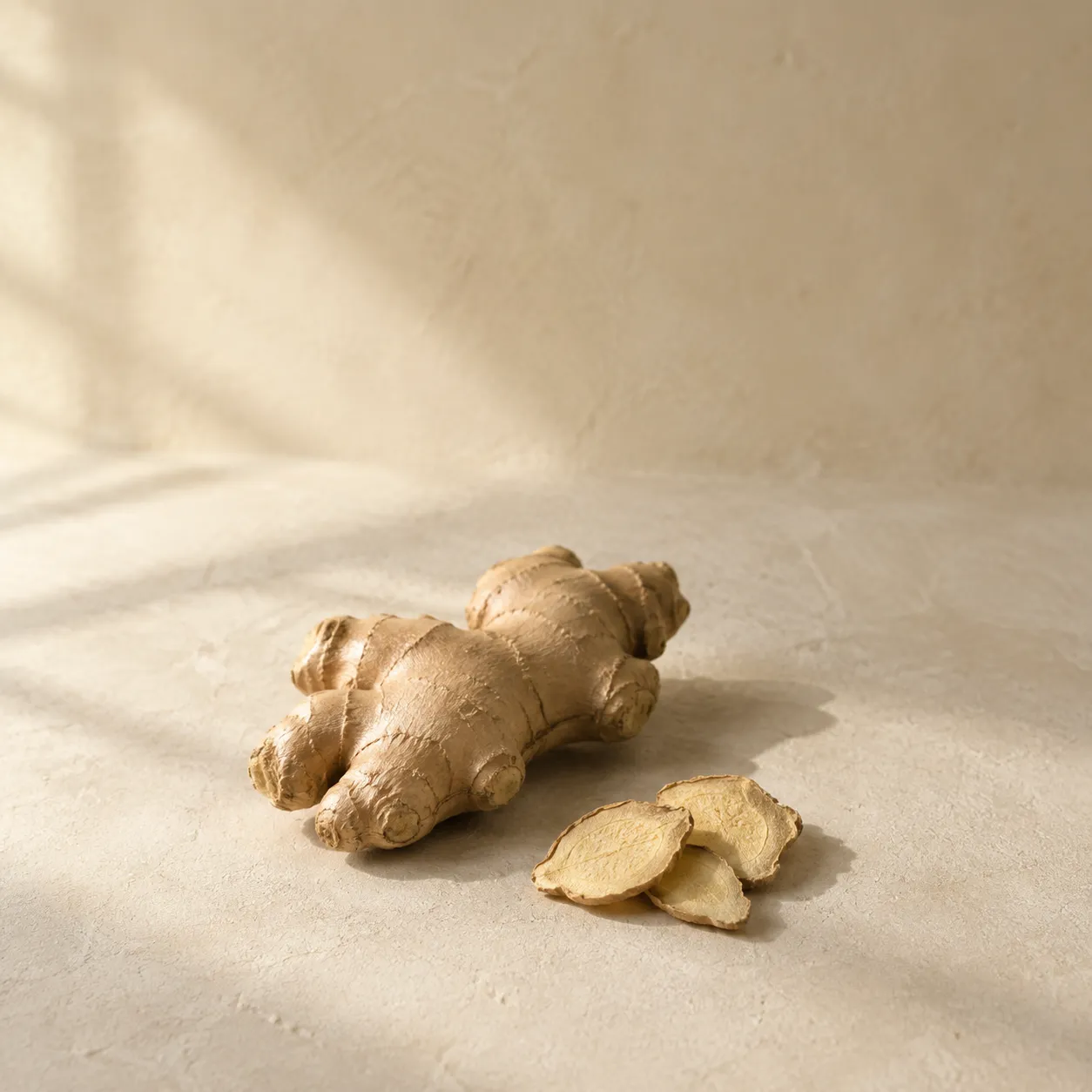
生姜Fresh ginger
HowThree or four coin-thin slices, skin left on, into hot water or into the pot at the start of cooking. Morning and midday rather than late evening.
Why hereWarmth you can put into food. For a picture of a cold middle and cold hands and feet, this is the plainest thing in the kitchen that does anything at all, and you almost certainly have it already.


Two to ease off
Iced drinks and raw salad at lunch
Not forever, and not because raw food is bad for anyone. Cold food only becomes useful once your own warmth has brought it up to temperature, and that warming is the work you currently have least of. Water at room temperature, and leaves wilted for thirty seconds in a hot pan, cost you nothing and hand the work back.
The sweet milky drink at three in the afternoon
Sweetness and dairy together are the two most common contributors to the thick wet coating we saw in your photograph, and three in the afternoon is exactly when your pattern is at its lowest. If you want to keep one thing, keep the coffee and leave out the milk and the syrup.
06
Two points you can reach
Two points, not twelve, because nobody keeps up twelve. Both are on the lower leg, both are found from a bone you can feel through the skin, and both are pressed with your own thumb. Nothing here involves a needle, and nothing here involves anybody touching you but you.

ST 36足三里Leg Three Li
- Finding it
- Sit down and bend the knee. Lay the palm of the same-side hand flat over the kneecap with the fingers pointing down the shin. Where your ring finger ends, move your thumb about one finger-width toward the outside of the leg — off the ridge of the shin bone and into the muscle beside it. The spot answers back: a dull ache that spreads, rather than a sharp one.
- Pressing it
- Steady thumb pressure, firm enough to feel clearly and not so firm that you hold your breath. One to two minutes on each leg, once a day, most days. The evening is as good a time as any.
- Note
- This is the most written-about point in the whole tradition; there is an old saying about pressing it rather than eating a chicken. If you miss it you will simply feel nothing much, which is how you know to move your thumb.
SP 9阴陵泉Yin Mound Spring
- Finding it
- Same seated position. Run your thumb slowly up the inside edge of the shin bone from the ankle, keeping contact with the bone the whole way. Just below the knee the bone turns inward and your thumb comes to rest in a hollow. That hollow is the point.
- Pressing it
- Thumb pressed into the hollow at a slight angle toward the bone, about a minute on each leg, once a day. On a picture like yours it is usually tender, which is how you will know you have found it.
- Note
- If it is very tender, use less pressure and stay longer rather than pressing harder. Tenderness is information, not a target.
Press over clothing or over skin, whichever you prefer. Stop if it becomes painful rather than achy, and leave a point alone if the skin over it is broken or bruised. If you are pregnant, or think you might be, do not begin any acupressure routine from a written report — that is a conversation to have with somebody in the room with you.
07
The season ahead
This report is written on 12 August. In the Chinese calendar you are eight days past 立秋, the Start of Autumn — the thirteenth of the twenty-four solar terms — and, in the older five-phase scheme, at the tail of 长夏, the late-summer season given to the spleen and to damp. That is not a coincidence of timing. These are the six weeks of the year in which your pattern is most visible, which is part of why it brought you to a form in August rather than in March.
Practically: for the next three or four weeks the air is carrying water, and cold raw food costs you more than it will in October. From about the third week of September the problem turns over. The air dries, and the same person who wanted warmth and dryness in August starts wanting moisture instead — pears stewed with a little rock sugar, white fungus, more soup and less toast. Do not carry an August routine into November without looking it up, and do not carry this one into a different body: it was written for the answers you gave us on the tenth.
Six weeks is a fair test of everything above. If nothing at all has shifted by the equinox, that is worth knowing, and it is worth telling someone who can put hands on you.